


“Breaking the Frame”: Filmmakers from the Balkans and Europe Discuss the Role of Women in Cinema
On February 25, Albanian Women in Audiovisual organized the conference “Breaking the Frame: Balkan Women Reimagine Cinema”, with the support of the French Ministry for Europe and Foreign Affairs, the French Embassy in Albania, Institut Français d’Albanie and the National Center of Cinematography. The conference was funded by the French Embassy in Albania.
The event brought together voices of filmmakers from Albania, the Balkans, France and Europe to discuss cinema and the inclusion of women in it, the challenges of the region and examples of policies from France and Europe on how these challenges can be overcome. With representatives from national film centers in the Balkans, delegates from the Centre National du Cinéma et de l’image animée (CNC) in France and Eurimages, as well as film producers from the region, the conference developed an open dialogue with more than 50 participants about the present and the future of cinema, possible collaborations and the role of public institutions.
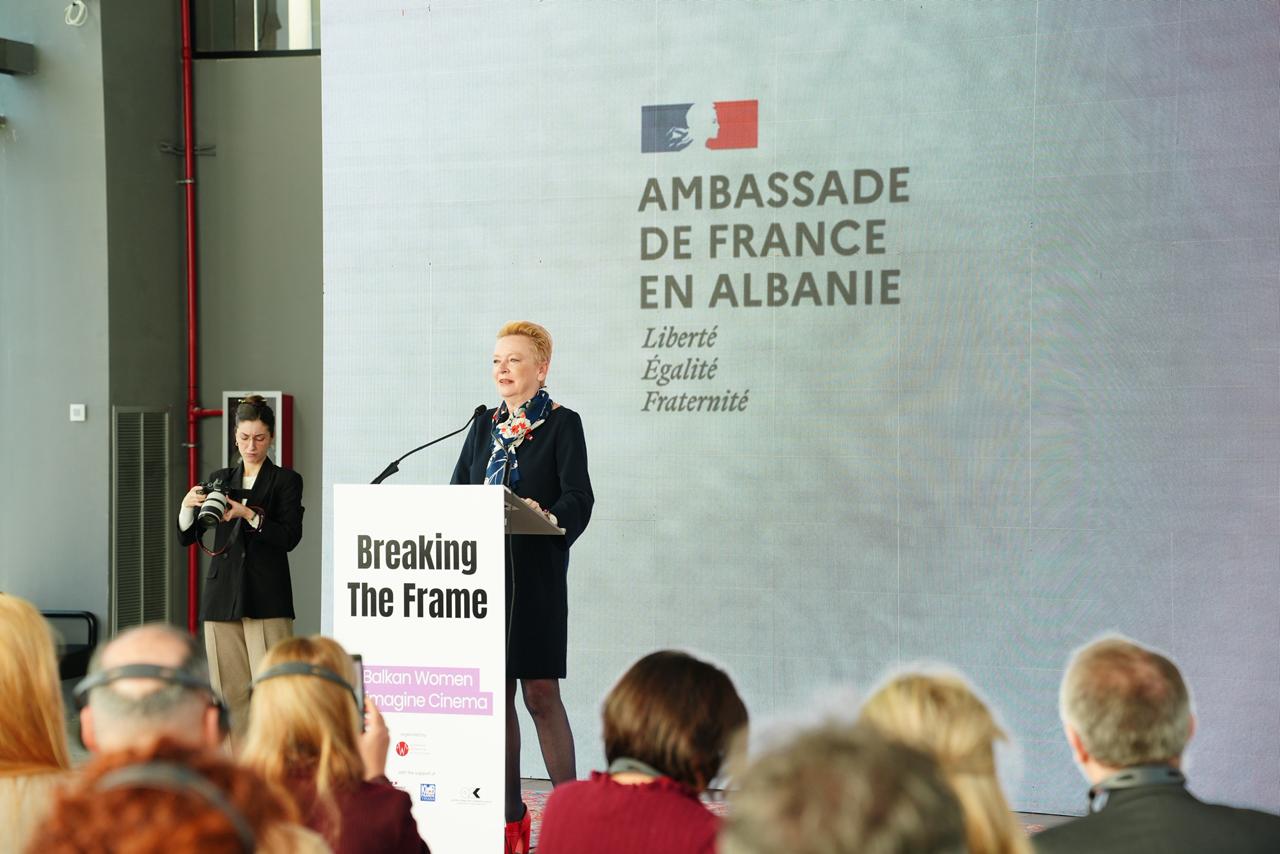
“Gender equality is part of our feminist diplomacy,” said Catherine Suard, Ambassador of France to Albania.
“I am very proud that in France we have integrated this into our policies and have established fair incentives for those who respect these standards,” Suard continued, stressing that although the number of women filmmakers has increased, it remains low and there is still much work to be done in this direction.
Lira Pipa, Deputy Minister of Tourism, Culture and Sport, stated that several reforms are being undertaken in Albania’s cinema law in order to change the situation.
“We are working with great commitment to move this sector forward and to develop policies that increase the inclusion of women as filmmakers and to see what we can do to strengthen the role of women in this sector,” Pipa said.
During the opening remarks, Jonid Jorgji, director of the National Center of Cinematography, stated that policies aimed at increasing women’s inclusion in cinema seek to ensure that they are not merely statistics.
“We are giving particular importance to meritocracy, so that the creative power of women determines the success of a cinematography,” he said.
Sabina Kodra, executive director of Albanian Women in Audiovisual, said that the conference symbolizes several years of work by a group of women filmmakers who felt they were not represented anywhere.
“Eight years ago, several women and girls gathered in a room many times smaller than this one to found AWA, because women were not at any table,” Kodra said. “We decided: if we don’t like the table, we will turn it upside down.”
Kodra emphasized that the conference comes at a moment of social polarization, when gender equality as a concept has become a taboo topic, while the conference itself aims to do the opposite: to build dialogue between the Balkans and the French and European realities, using them as a compass for inclusive policies—something that until recently could only be imagined as a dream.
“All it took was imagination to reimagine what could bring us together: how the better half of humanity can find its place in cinema,” she concluded.
The reality in Europe: Far from being equal
In the first panel, Laetitia Kulyk from CNC France, part of the Ministry of Culture in France, discussed in greater detail how they managed to ensure a more equal inclusion of women in cinema. Initially, Kulyk emphasized that the bonus policy was used, where films that included women filmmakers could benefit from additional support. According to her, the approach has now changed.
“The Ministry of Culture has started working with a penalty mechanism as well – we now consider equality to be normal, and when it is absent, there will be penalties,” she said, adding that there is still work to be done, as the pay gap between women and men for the same job remains around 20 percent.
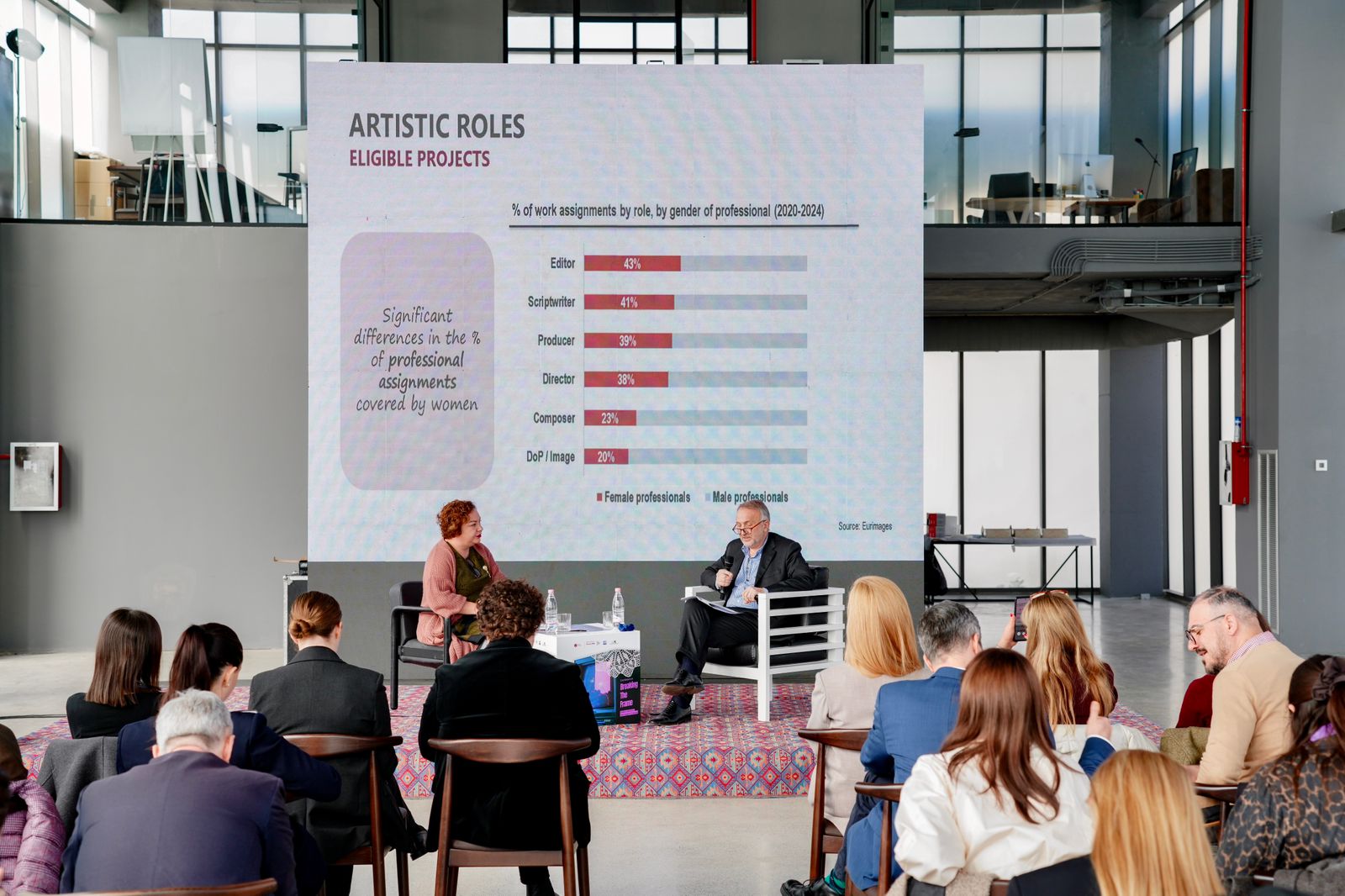
Meanwhile, data from the European Audiovisual Observatory show another picture for Europe.
“Women are still underrepresented in the film industry. Only 24 percent of all professional engagements in European films between 2020 and 2024 were given to women,” said Enrico Vannucci from Eurimages.
For this reason, encouraging policies for the inclusion of women in cinema remain necessary, said Elena Christodoulidou from the Cyprus Cinema Office.
“In the financial sector we do not have the same discussion; there is no need to encourage women to participate. In cinema, on the contrary, we need to encourage them,” she said during one of the panels, calling cinema “a man’s world.” “Statistics show that there is one woman director for every three male directors.”
Kosovo: A Different Reality for Women Filmmakers Where the Numbers Are Reversed
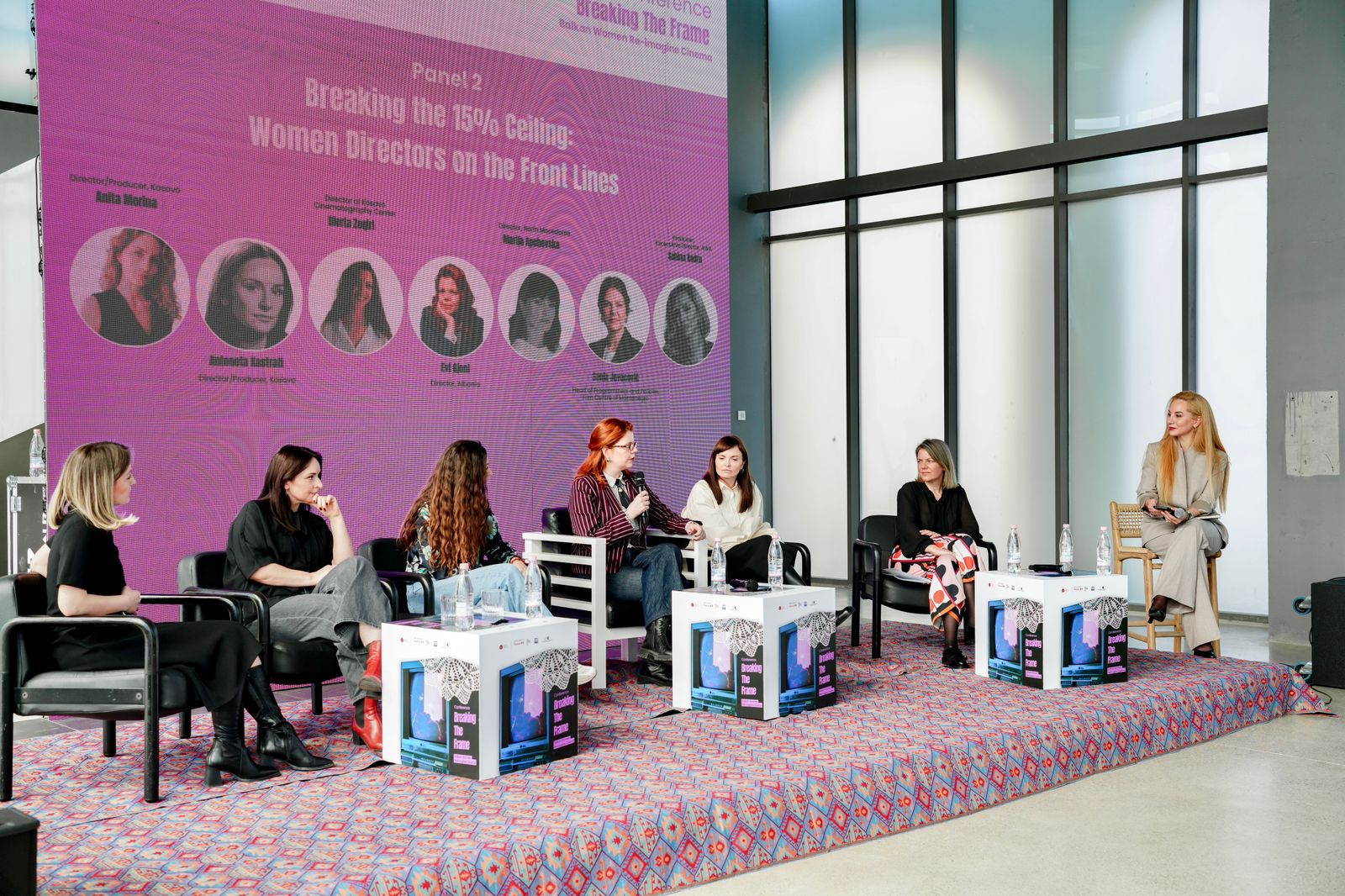
Since 2021, a “new wave” of women directors has begun in Kosovo, where we see greater inclusion of women than men.
Blerta Zeqiri, director of the Kosovo Cinematography Center, said that although there is no precise answer as to why this has happened, she is aware of the impact of women in Kosovo’s society.
“In our society, women are present in every sphere and this has also helped the film sector,” Zeqiri said. “The patriarchal way of being is still very present, but the reality is that women in Kosovo are very courageous, talented and strong.”
Antoneta Kastrati, a producer from Kosovo, explained that sisterhood has been a very important element in the success of women in cinema.
“We created our own micro-system and grew together, helping one another. We are all very connected with each other.”
“Sisterhood has flourished in Kosovo,” said Anita Morina, a director. “When you are oppressed, the need to dream more and to become better than the oppressor becomes even stronger,” she added.
In the Albanian context, the situation is not the same, although there have been improvements, added director Evi Gjoni.
“When I started studying film, they told me it was a man’s field. Now I see more and more women in film crews; at the university, at the beginning there were only men.”
The Need for More Regional Cooperation and the Challenges
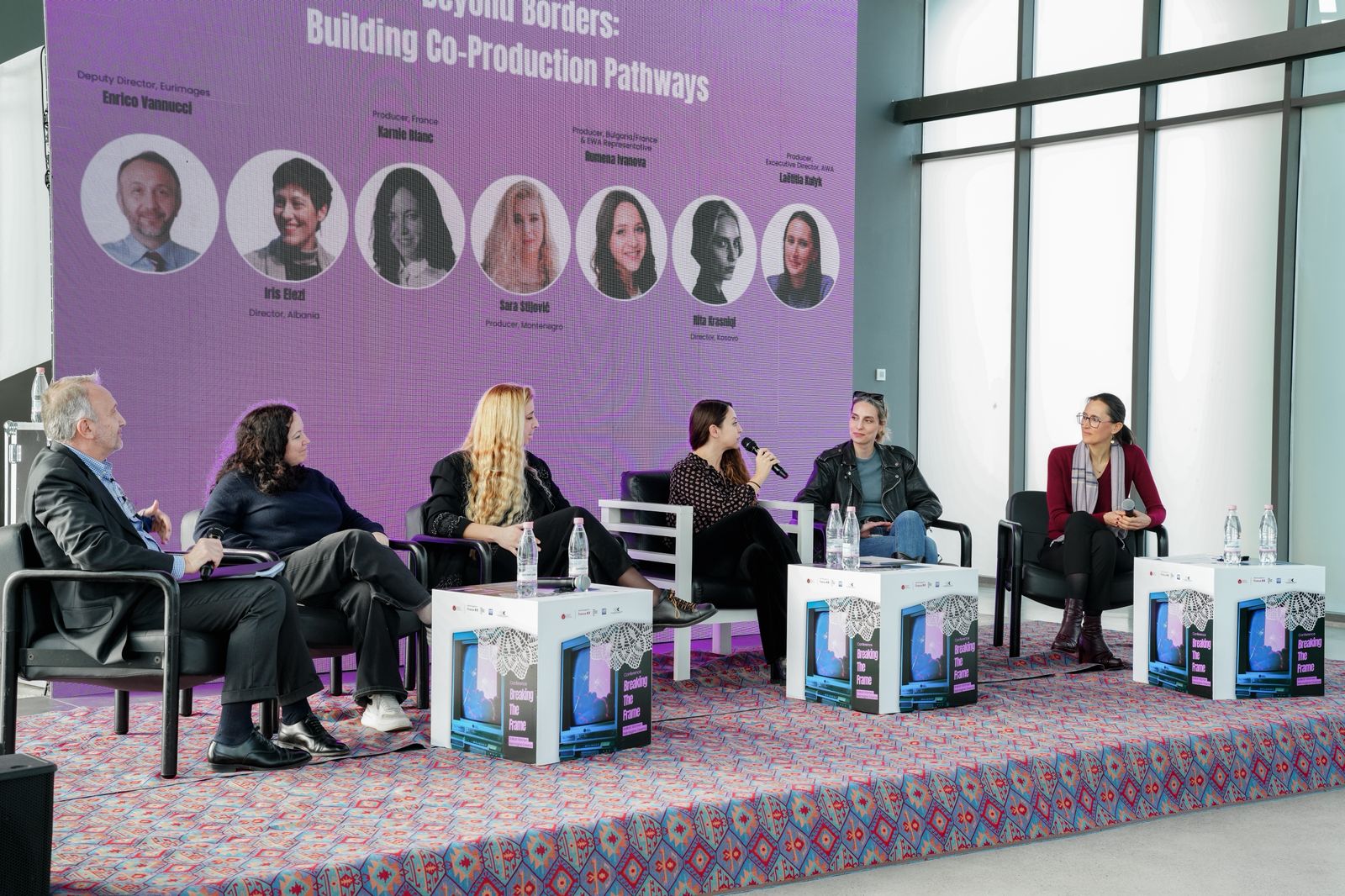
Sara Stijović, a producer from Montenegro, said that being a woman in this industry in the Balkans is very difficult. “On average, the number of feature films produced each year ranges between zero and two or three,” she added.
Regarding cooperation in the region and in Europe, the administrative bureaucracy of the European Union is mentioned as one of the main obstacles.
“I am still learning a lot and I have never applied to Eurimages. There are several reasons, including the limitations,” added Sara Stijović. “We lack the knowledge of how to read contracts or how to give these applications a chance.”
Rita Krasniqi, a producer from Kosovo, said that another problem that complicates cooperation is time and geography.
Rumena Ivanova, a producer from Bulgaria and also a representative of the European Women’s Audiovisual Network (EWA), said that good cooperation also depends on the partner.
“I believe an important factor is choosing the right partner, and this is not easy; it also has to do with the human connection that comes with trust.” Another important element raised in the discussion was a shared vision.
“We need to be clear and speak honestly,” said Karnie Blanc, a producer from France. “And share the same vision,” she concluded.
The conference concluded with a call for more inclusive policies for women filmmakers and greater cooperation in the region.